









- Forum
- categories
- Sanitation systems
- Treatment of wastewater, sludges, organic waste, excreta
- Various other technologies and comparisons of treatment technologies
- Windmill-driven ATADS
Windmill-driven ATADS
40.7k views

- Elisabeth
-
- Moderator
- Freelance consultant since 2012 (former roles: program manager at GIZ and SuSanA secretariat, lecturer, process engineer for wastewater treatment plants)
Less- Posts: 3372
- Karma: 54
- Likes received: 931
Dear Jim,
Ah, terminologies... Just a small correction: faecal sludge consists of faeces + urine + water. You get it from septic tanks and from pit latrines. Even though the pit latrines are "dry" toilets (unless they are pour flush pit latrines) usually when emptying them, water needs to be added to get the stuff out of the pit (especially if you want to use a pump or any mechanised equipment).
For the ATAD to work, I assume you need to have a sludge or slurry where the total solids content is not too high (or put in other words: you need a minimum water content). Which dry solids content do you envisage to be still workable? Primary sludge has a dry solids content of about 3-5% if I remember right (= 30,000 to 50,000 mg/L of solids). Faecal sludge will usually be higher. Could aeration still work if you have something like a "cake" from a belt press which is 12% d.s.? I can't imagine that it would (?).
Regards,
Elisabeth
Ah, terminologies... Just a small correction: faecal sludge consists of faeces + urine + water. You get it from septic tanks and from pit latrines. Even though the pit latrines are "dry" toilets (unless they are pour flush pit latrines) usually when emptying them, water needs to be added to get the stuff out of the pit (especially if you want to use a pump or any mechanised equipment).
For the ATAD to work, I assume you need to have a sludge or slurry where the total solids content is not too high (or put in other words: you need a minimum water content). Which dry solids content do you envisage to be still workable? Primary sludge has a dry solids content of about 3-5% if I remember right (= 30,000 to 50,000 mg/L of solids). Faecal sludge will usually be higher. Could aeration still work if you have something like a "cake" from a belt press which is 12% d.s.? I can't imagine that it would (?).
Regards,
Elisabeth
Dr. Elisabeth von Muench
Freelance consultant on environmental and climate projects
Located in Ulm, Germany
This email address is being protected from spambots. You need JavaScript enabled to view it.
My Wikipedia user profile: en.wikipedia.org/wiki/User:EMsmile
LinkedIn: www.linkedin.com/in/elisabethvonmuench/
Freelance consultant on environmental and climate projects
Located in Ulm, Germany
This email address is being protected from spambots. You need JavaScript enabled to view it.
My Wikipedia user profile: en.wikipedia.org/wiki/User:EMsmile
LinkedIn: www.linkedin.com/in/elisabethvonmuench/
The topic has been locked.

Thanks again for your interest and suggestions. You are right, we are dealing with the whole human waste, urine plus fecal material. I believe you call this faecal sludge, we've been using the term excreta. It is not dry, but beacuse it is wet, it is well known that thermal disinfection processes are very effective. Thanks for the reference lead, too. Regards, Jim
The topic has been locked.
- Elisabeth
-
- Moderator
- Freelance consultant since 2012 (former roles: program manager at GIZ and SuSanA secretariat, lecturer, process engineer for wastewater treatment plants)
Less- Posts: 3372
- Karma: 54
- Likes received: 931
Aha, I was also at AfricaSan 3 so you might have seen me present in one of the SuSanA sessions (and true: we added the e-mail addresses of those who attended and who gave their e--mail address to the SuSanA news mailing list - I hope that was not too cheeky and that you didn't mind).
Thanks for the detailed explanations, very useful! I think you will need to decide sooner or later if your ultimate application will be faecal sludge or pure excreta. Two very different things. Faecal sludge could be vaguely similar to your primary sludge (although with a lower water content). But faeces from dry systmes is a totally different story. For the later, it no longer makes sense to try and measure COD - COD is for concentrations in liquids, but here you have "solid" matter.
Based on what you describe with the fine bubble diffuser airstones, you will always need a waste which is rather liquidy. So I guess it will be faecal sludge. There are many good publications from Sandec on faecal sludge characteristics, you find some of them in the SuSanA library by putting into the search field "faecal sludge" here: www.susana.org/library
A recent publication from South Africa which seems to be very good and comprehensive is this one:
www.susana.org/lang-en/library?view=ccbktypeitem&type=2&id=1243
WIN-SA (2011). What happens when the pit is full? - Developments in on-site faecal sludge management (FSM). Water Information Network South Africa. Proceedings from FSM Seminar, 14-15 March 2011 in Durban, South Africa.
Hope this helps a little bit.
Regards,
Elisabeth
Thanks for the detailed explanations, very useful! I think you will need to decide sooner or later if your ultimate application will be faecal sludge or pure excreta. Two very different things. Faecal sludge could be vaguely similar to your primary sludge (although with a lower water content). But faeces from dry systmes is a totally different story. For the later, it no longer makes sense to try and measure COD - COD is for concentrations in liquids, but here you have "solid" matter.
Based on what you describe with the fine bubble diffuser airstones, you will always need a waste which is rather liquidy. So I guess it will be faecal sludge. There are many good publications from Sandec on faecal sludge characteristics, you find some of them in the SuSanA library by putting into the search field "faecal sludge" here: www.susana.org/library
A recent publication from South Africa which seems to be very good and comprehensive is this one:
www.susana.org/lang-en/library?view=ccbktypeitem&type=2&id=1243
WIN-SA (2011). What happens when the pit is full? - Developments in on-site faecal sludge management (FSM). Water Information Network South Africa. Proceedings from FSM Seminar, 14-15 March 2011 in Durban, South Africa.
Hope this helps a little bit.
Regards,
Elisabeth
Dr. Elisabeth von Muench
Freelance consultant on environmental and climate projects
Located in Ulm, Germany
This email address is being protected from spambots. You need JavaScript enabled to view it.
My Wikipedia user profile: en.wikipedia.org/wiki/User:EMsmile
LinkedIn: www.linkedin.com/in/elisabethvonmuench/
Freelance consultant on environmental and climate projects
Located in Ulm, Germany
This email address is being protected from spambots. You need JavaScript enabled to view it.
My Wikipedia user profile: en.wikipedia.org/wiki/User:EMsmile
LinkedIn: www.linkedin.com/in/elisabethvonmuench/
The topic has been locked.
Dear Elisabeth (and all),
Thank you for your reply and interest. You asked very probing, but central questions about the technology and our work. I will try to answer them. Pardon the outline format, but this helps me address all of your questions.
1) We started the grant in May of this year (although I have about 8 years of experience in this particular technology with raw animal waste). I found out about your forum because I attended Africasans 3 this summer and apparently was put on a mailing list. I am excited to talk, interact, and learn with other global experts about the human sanitation problems of the developing world. This is why I joined the forum.
2) We are taking the primary sludge from our city WWTP for two reasons, real excreta is hard to come by in the US (at least anywhere near our University), and primary sludge at our plant has the highest solids and COD concentration of anywhere in the treatment plant. It is about 33 g/L Total COD. While I have been unable to actually locate literature on COD characteristics on excreta from the very poor in developing countries, I have cobbled together an estimate from several global health internet sources suggesting it may be around 50 g/L total COD. There is no question that while the physical/ chemical/ biological characteristics will be much different (eg viscosity/ particle or "lump" size distribution, etc.) our proposed and current focus is to demonstrate in a system exposed to the wind and weather with human waste, that we can maintain a 55-65 C temperature for 10 days residence time for 6+ months. By the way, if anybody can help lead me to physical/chemical/biological data on excrement from our target group of people, I would be delighted.
This is the focus of our "seed money" grant and we are aware that engineering problems remain to be addressed if we are fortunate enough to gain a BMGF second phase grant. Also, the trial in a developing country is planned for the second phase and will be the prime focus of a second phase grant... the country to be determined by ourselves, the BMGF and other interested parties in the world.
3) You are correct that in this day of anaerobic digestion, ATADs are relatively obscure. In the latest edition of "Metcalf and Eddy, Fourth Ed., 2003" out of over 1800 pages, there are 5-6 pages dedicated to ATADs. However, in the sections devoted to pathogen removal, including helmith eggs, The US uses a Classification for Biosolids A which, if met, allows unrestricted agricultural use of the remaining treated solids, at least from a pathogen standpoint. In Table 14-11 (pg 1464) from the above reference, thermophilic aerobic digestion is listed as one of the accepted process to further reduce pathogens (PFRP). All literature I have seen indicates that if these conditions are met, helmith eggs will be removed to the detction limit. Of course, we don't know the effects of the physical properties of excreta.
We are planning to work with Profs. Michel and Galas from the "Servicio Enterobacterias”, the National Reference Laboratory for Enterobacteriaceae,“Instituto Nacional de Enfermedades Infecciosas - ANLIS Carlos G. Malbrán” in Argentina to explore the effects of survival of Cholera and Shigella in excreta at these conditions. When I applied for the BMGF grant Acute Diarrheal Diseases were the Foundation's focus. Profs. Michel's and Galas' work may result in a clue as to the matrix effects on pathogen survival.
3) A very good and recent review of the ATAD field is available in Juteau, P, 2006, Livestock Science 102: 187-196. Briefly, it is well known (confirmed over and over again by famous investigators in Environmental Engineering and other fields and traceable back to chemical theromodynamics at least 100 years ago) that about 14 Mj/(kg of oxygen removed) of heat is made regardless of organic waste, organism or conditions (within reason). ATADS simply add oxygen, mostly using air and manages the heat of biooxidation to maintain thermophilic temperatures. This requires a COD source (only a fraction is used by microorganisms), sufficient oxygen transfer to maximize heat production, good insulation and concern for the two big heat losses (hot mixed liquor removed and water saturated air (offgas) leaving the system. This hot air at reactor temperatures carries away significant amounts of evaporated water at 0.62 Mj/kg air at 65 C. All applications of which I am aware (including our past work) have carefully metered and controlled the air input (current US patent activity focuses on this), because it both controls the heat production and heat loss rates. These systems use electricity (lots of it) and expensive blowers.
We are exploring if the air provided in a windmill fitted with a rugged blower (not a pump or generator) can be used with the variable wind outside in the weather to hold the temperatures and residence times necessary for deep pathogen kill. Specifically this is a commercial windmill about 9-m high used for fish pond aeration and can be found on the internet worldwide. We are using a fine bubble diffuser air stone. We have done our own engineering tests and have established the performance data up to 4 feet of water head. This application will not require much deeper systems than that.
4) In Carbondale, we are addressing (spending our seed money) on the engineering issues and only measuring fecal coliform/E. coli by an EPA Certified laboratory. While our University has the knowhow for broader pathogen analysis and has famous investigators in these areas, we just don't have the funds. We are relying on the mass of literature sugggesting helmith eggs won't survive the reactor conditions and trying to establish that the reactor conditions can be held even with variable and even no wind (at least for limited durations).
I think I've addressed your questions and am anxious for comments and responses.
By the way, I'm attaching an unpublished steady-state modeled result showing that with current knowledge, we expect that the system will maintain the temperatures here in Carbondale in January.
Best Regards, Jim
Thank you for your reply and interest. You asked very probing, but central questions about the technology and our work. I will try to answer them. Pardon the outline format, but this helps me address all of your questions.
1) We started the grant in May of this year (although I have about 8 years of experience in this particular technology with raw animal waste). I found out about your forum because I attended Africasans 3 this summer and apparently was put on a mailing list. I am excited to talk, interact, and learn with other global experts about the human sanitation problems of the developing world. This is why I joined the forum.
2) We are taking the primary sludge from our city WWTP for two reasons, real excreta is hard to come by in the US (at least anywhere near our University), and primary sludge at our plant has the highest solids and COD concentration of anywhere in the treatment plant. It is about 33 g/L Total COD. While I have been unable to actually locate literature on COD characteristics on excreta from the very poor in developing countries, I have cobbled together an estimate from several global health internet sources suggesting it may be around 50 g/L total COD. There is no question that while the physical/ chemical/ biological characteristics will be much different (eg viscosity/ particle or "lump" size distribution, etc.) our proposed and current focus is to demonstrate in a system exposed to the wind and weather with human waste, that we can maintain a 55-65 C temperature for 10 days residence time for 6+ months. By the way, if anybody can help lead me to physical/chemical/biological data on excrement from our target group of people, I would be delighted.
This is the focus of our "seed money" grant and we are aware that engineering problems remain to be addressed if we are fortunate enough to gain a BMGF second phase grant. Also, the trial in a developing country is planned for the second phase and will be the prime focus of a second phase grant... the country to be determined by ourselves, the BMGF and other interested parties in the world.
3) You are correct that in this day of anaerobic digestion, ATADs are relatively obscure. In the latest edition of "Metcalf and Eddy, Fourth Ed., 2003" out of over 1800 pages, there are 5-6 pages dedicated to ATADs. However, in the sections devoted to pathogen removal, including helmith eggs, The US uses a Classification for Biosolids A which, if met, allows unrestricted agricultural use of the remaining treated solids, at least from a pathogen standpoint. In Table 14-11 (pg 1464) from the above reference, thermophilic aerobic digestion is listed as one of the accepted process to further reduce pathogens (PFRP). All literature I have seen indicates that if these conditions are met, helmith eggs will be removed to the detction limit. Of course, we don't know the effects of the physical properties of excreta.
We are planning to work with Profs. Michel and Galas from the "Servicio Enterobacterias”, the National Reference Laboratory for Enterobacteriaceae,“Instituto Nacional de Enfermedades Infecciosas - ANLIS Carlos G. Malbrán” in Argentina to explore the effects of survival of Cholera and Shigella in excreta at these conditions. When I applied for the BMGF grant Acute Diarrheal Diseases were the Foundation's focus. Profs. Michel's and Galas' work may result in a clue as to the matrix effects on pathogen survival.
3) A very good and recent review of the ATAD field is available in Juteau, P, 2006, Livestock Science 102: 187-196. Briefly, it is well known (confirmed over and over again by famous investigators in Environmental Engineering and other fields and traceable back to chemical theromodynamics at least 100 years ago) that about 14 Mj/(kg of oxygen removed) of heat is made regardless of organic waste, organism or conditions (within reason). ATADS simply add oxygen, mostly using air and manages the heat of biooxidation to maintain thermophilic temperatures. This requires a COD source (only a fraction is used by microorganisms), sufficient oxygen transfer to maximize heat production, good insulation and concern for the two big heat losses (hot mixed liquor removed and water saturated air (offgas) leaving the system. This hot air at reactor temperatures carries away significant amounts of evaporated water at 0.62 Mj/kg air at 65 C. All applications of which I am aware (including our past work) have carefully metered and controlled the air input (current US patent activity focuses on this), because it both controls the heat production and heat loss rates. These systems use electricity (lots of it) and expensive blowers.
We are exploring if the air provided in a windmill fitted with a rugged blower (not a pump or generator) can be used with the variable wind outside in the weather to hold the temperatures and residence times necessary for deep pathogen kill. Specifically this is a commercial windmill about 9-m high used for fish pond aeration and can be found on the internet worldwide. We are using a fine bubble diffuser air stone. We have done our own engineering tests and have established the performance data up to 4 feet of water head. This application will not require much deeper systems than that.
4) In Carbondale, we are addressing (spending our seed money) on the engineering issues and only measuring fecal coliform/E. coli by an EPA Certified laboratory. While our University has the knowhow for broader pathogen analysis and has famous investigators in these areas, we just don't have the funds. We are relying on the mass of literature sugggesting helmith eggs won't survive the reactor conditions and trying to establish that the reactor conditions can be held even with variable and even no wind (at least for limited durations).
I think I've addressed your questions and am anxious for comments and responses.
By the way, I'm attaching an unpublished steady-state modeled result showing that with current knowledge, we expect that the system will maintain the temperatures here in Carbondale in January.
Best Regards, Jim
This message has an attachment file.
Please log in or register to see it.
The topic has been locked.
- Elisabeth
-
- Moderator
- Freelance consultant since 2012 (former roles: program manager at GIZ and SuSanA secretariat, lecturer, process engineer for wastewater treatment plants)
Less- Posts: 3372
- Karma: 54
- Likes received: 931
Dear Jim,
Nice to see you on this forum, I feel honoured that a professor from the US has posted here (how did you find out about this forum?).
Is your prototype going to take primary sludge from a primary settling tank at a WWTP?
This will be much more dilute than if you take faecal sludge from pit latrines though. Will the results really be comparable?
I vaguely remember the ATAD process from my dim distant past when I was a process engineer designing wastewater treatment plants back in the nineties... But can you remind me again how the aerobic part is done, i.e. what is done to aerate the sludge? You take the windmill to provide the power to get air bubbling through the sludge (how?)?
Are you confident that the ATAD process will destroy even the most persistent of pathogens, i.e. the helminth eggs? Will you spike with eggs, since most likely there won't be that many in the primary sludge (healthy Americans).
Which country do you have in mind to test it with real world conditions?
Regards,
Elisabeth
Nice to see you on this forum, I feel honoured that a professor from the US has posted here (how did you find out about this forum?).
Is your prototype going to take primary sludge from a primary settling tank at a WWTP?
This will be much more dilute than if you take faecal sludge from pit latrines though. Will the results really be comparable?
I vaguely remember the ATAD process from my dim distant past when I was a process engineer designing wastewater treatment plants back in the nineties... But can you remind me again how the aerobic part is done, i.e. what is done to aerate the sludge? You take the windmill to provide the power to get air bubbling through the sludge (how?)?
Are you confident that the ATAD process will destroy even the most persistent of pathogens, i.e. the helminth eggs? Will you spike with eggs, since most likely there won't be that many in the primary sludge (healthy Americans).
Which country do you have in mind to test it with real world conditions?
Regards,
Elisabeth
Dr. Elisabeth von Muench
Freelance consultant on environmental and climate projects
Located in Ulm, Germany
This email address is being protected from spambots. You need JavaScript enabled to view it.
My Wikipedia user profile: en.wikipedia.org/wiki/User:EMsmile
LinkedIn: www.linkedin.com/in/elisabethvonmuench/
Freelance consultant on environmental and climate projects
Located in Ulm, Germany
This email address is being protected from spambots. You need JavaScript enabled to view it.
My Wikipedia user profile: en.wikipedia.org/wiki/User:EMsmile
LinkedIn: www.linkedin.com/in/elisabethvonmuench/
The topic has been locked.
Hi, Thanks for your question. First I'm James Blackburn of the Department of Mecahnical Engineering and energy process at Southern Illinois University in Carbondale, IL, USA. My email is This email address is being protected from spambots. You need JavaScript enabled to view it.. I'm a Professor, but am trained and worked my career as an environmental/bichemical engineer.
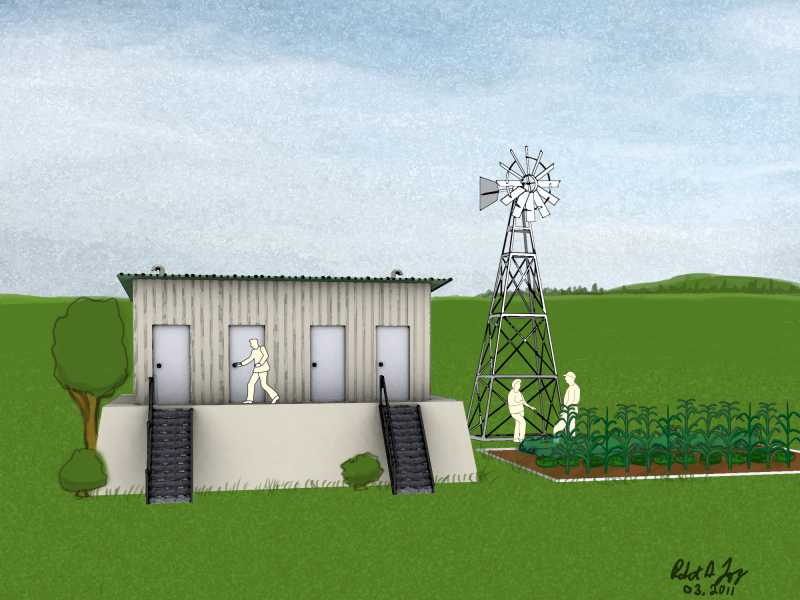
I'm forwarding a "vision" of what this system might eventually look like. We are now working on a 100 gal prototype to be installed at the Carbondale NW WWTP Primary Sludge Effluent for operation as long as possible. The current seed money grant will allow us to run about 6+ months. The purpose is to test a small ATAD (100 wet gallons)on human waste (I have a lot of experience with swine waste and it's kinetics in ATAD systems) in real weather conditions. Carbondale's wind conditions are marginal so there will be times when the system goes anaerobic/anoxic, however the thermal mass may allow maintenance of sufficient temperatures to bridge many of the calm times. The system is designed for whole excreta. With this information we should be eventually able to identify characteristics of an actual (developing world) site which should be met for application. It will not be capable of solving the whole global problem, but may offer and alternative where wind conditions are good. We're hoping that that may be as high as 50% of the global problem. Our design objectives are wind power only (no electricity or fuel), small, agricultural-type windmill with an air blower-not water pump or generator), US Biosolids A product (10 days, 51-65 C) and minimal maintenance. The wet product should be safe for any agricultural use or even to seed solid compost systems with thermophile-enriched biosolids. We're targeting the people whom today only have pit latrine or open defecation options. I'll be glad to elaborate as requested.
My best regards, Jim
I'm forwarding a "vision" of what this system might eventually look like. We are now working on a 100 gal prototype to be installed at the Carbondale NW WWTP Primary Sludge Effluent for operation as long as possible. The current seed money grant will allow us to run about 6+ months. The purpose is to test a small ATAD (100 wet gallons)on human waste (I have a lot of experience with swine waste and it's kinetics in ATAD systems) in real weather conditions. Carbondale's wind conditions are marginal so there will be times when the system goes anaerobic/anoxic, however the thermal mass may allow maintenance of sufficient temperatures to bridge many of the calm times. The system is designed for whole excreta. With this information we should be eventually able to identify characteristics of an actual (developing world) site which should be met for application. It will not be capable of solving the whole global problem, but may offer and alternative where wind conditions are good. We're hoping that that may be as high as 50% of the global problem. Our design objectives are wind power only (no electricity or fuel), small, agricultural-type windmill with an air blower-not water pump or generator), US Biosolids A product (10 days, 51-65 C) and minimal maintenance. The wet product should be safe for any agricultural use or even to seed solid compost systems with thermophile-enriched biosolids. We're targeting the people whom today only have pit latrine or open defecation options. I'll be glad to elaborate as requested.
My best regards, Jim
Attachments:
-
 Final_J_Bl...ring.jpg
(Filesize: 40KB)
Final_J_Bl...ring.jpg
(Filesize: 40KB)
The topic has been locked.
- Elisabeth
-
- Moderator
- Freelance consultant since 2012 (former roles: program manager at GIZ and SuSanA secretariat, lecturer, process engineer for wastewater treatment plants)
Less- Posts: 3372
- Karma: 54
- Likes received: 931
Thanks for posting here and congratulations on winning this grant from Bill and Melinda Gates Foundation! Can you tell us more? What are the applications exactly, what is the raw material, is it faecal sludge or just faeces?
What do you mean by "deployable"? Where and how will you trial it?
(and can you tell us a few more words about yourself and where you work?)
Regards,
Elisabeth
What do you mean by "deployable"? Where and how will you trial it?
(and can you tell us a few more words about yourself and where you work?)
Regards,
Elisabeth
Dr. Elisabeth von Muench
Freelance consultant on environmental and climate projects
Located in Ulm, Germany
This email address is being protected from spambots. You need JavaScript enabled to view it.
My Wikipedia user profile: en.wikipedia.org/wiki/User:EMsmile
LinkedIn: www.linkedin.com/in/elisabethvonmuench/
Freelance consultant on environmental and climate projects
Located in Ulm, Germany
This email address is being protected from spambots. You need JavaScript enabled to view it.
My Wikipedia user profile: en.wikipedia.org/wiki/User:EMsmile
LinkedIn: www.linkedin.com/in/elisabethvonmuench/
The topic has been locked.
 Hi:
Hi:In a Bill and Melinda Gates Foundation Grand Challenges Exploration Grant we are developing a deployable, 9-m windmill driven system with no electrical power to achieve deep pathogen removal using autothermal thermophilic aerobic digestion on a small scale. I would be interested in any and all comments/ contributions this group might want to make. Regards all, Jim Blackburn
The topic has been locked.
Share this thread:
- Forum
- categories
- Sanitation systems
- Treatment of wastewater, sludges, organic waste, excreta
- Various other technologies and comparisons of treatment technologies
- Windmill-driven ATADS
Time to create page: 0.110 seconds