









- Forum
- categories
- Markets, finance and governance
- Financing (taxes, tariffs, transfers) and cost estimates
- Re: Toolkit, guideline and excel model for a standardised approach to cost-benefit analysis
Re: Toolkit, guideline and excel model for a standardised approach to cost-benefit analysis
18.1k views

- Elisabeth
-

- Moderator
- Freelance consultant since 2012 (former roles: program manager at GIZ and SuSanA secretariat, lecturer, process engineer for wastewater treatment plants)
Less- Posts: 3372
- Karma: 54
- Likes received: 931
Note at the end of the article you can sign up for updates and have the chance to become an early user tester.
www.washcost.info/page/2907
+++++++++++++++
IRC first revealed sketches of the WASHCost Calculator at the Monitoring Sustainable WASH Service Delivery symposium organised by IRC in April 2013. We received feedback from future users including NGOs, governments and donors at the symposium, at a WASHCost training, and during partner visits. Online user testing of the beta version of the tool will be starting in July in preparation for the final version scheduled to be released in October 2013.
The Calculator is an intuitive & dynamic life-cycle costs app for the evaluation of water, sanitation and hygiene services. Using the sketches, IRC was able to test the way people navigate through the tool and been extremely helpful to reveal the most valuable functions. Users would like to be able to track water and sanitation services over time to show how they are performing against expectations. They would also like to see how their services compare against others in terms of cost and level of service.
The tool will cater to both those who are just getting started with life-cycle costs and service levels and more advanced users who are applying the life-cycle costs approach. In both cases, the tool provides quick feedback on the cost of providing a service and on the planned or real level of service achieved. It will provide comparisons against WASHCost benchmarks, existing water and sanitation services, and the data of other organisations. The WASHCost benchmarks represent the best available data, based on both breadth and methodology, and provide easy to understand outputs that can help users refine the services they are planning and delivering.
Some ways users have said they would like to use the tool include:
Training district staff on the life-cycle costs approach
Tracking services over time
Comparing the costs in new proposals against historical data
Visualising life-cycle costs information for a country or programme
Timeline
Since the end of 2012, IRC has been working with Hattery to make the WASHCost Calculator a success. Hattery, based in San Francisco, is providing consultancy services to improve the marketing and development of the Calculator to ensure that it achieves a high standard on par with the best digital products from Silicon Valley. Since February 2013, the product development firm, Native, has been contracted to build the tool. In October 2013, the version 1.0 of the WASHCost Calculator will be publicly released.
In addition to the development team, key partners are providing support to the development of the tool by providing feedback after testing the tool and by providing additional life-cycle costs data. The WASHCost Calculator will be released publicly in two stages:
WASHCost Calculator Beta, Expected August 2013
WASHCost Calculator 1.0, Expected October 2013
December 2012 – January 2013
IRC and Hattery start the WASHCost Calculator project and begin to recruit a product development firm through a tender process.
February 2013
Product development firm, Native, is selected. IRC, Native and Hattery meet to start to work out the requirements of the tool. IRC approaches organisations with life-cycle costs data to encourage them to provide feedback during user testing and to improve the tool outputs. If you are interested in sharing life-cycle costs and service level information with the WASHCost project, please contact Nick Dickinson by emailing This email address is being protected from spambots. You need JavaScript enabled to view it..
March 2013
Development of wireframes (sketches) of the basic version of the water service tool. www.washcost.org is set up to allow people to sign up for updates. This site will be used as the product site when it goes live.
April 2013
Wireframes tested with users at the IRC symposiumMonitoring Sustainable WASH Service Deliveryin Ethiopia. New WASHCost brand developed for WASHCost products. The user data that the WASHCost Calculator will use to generate outputs is defined in detail.
May 2013
Additional user testing incorporated into an advanced WASHCost training in Nairobi. The tool internal logic and calculations are refined before the development of the database. Final WASHCost brand selected. Partners approached for life-cycle costs data. The database and tool software development begins for the beta version of the tool
June - July 2013
Database and interface are tested online. Draft terms of use and privacy agreements developed for feedback. First testing of data import and export functionalities with the global life-cycle costs database.
July 2013
User-testing completed. Changes based on user feedback are incorporated into the tool. WASHCost Calculator 1.0 development begins.
August 2013
Life-cycle data from third party data sets is incorporated into the WASHCost Calculator to improve country-level and global comparisons.
September 2013
WASHCost Calculator Beta released and shared at the Stockholm World Water Week 2013, 1 – 6 September. WASHCost 1.0 user tested.
October 2013
User feedback incorporated into the WASHCost Calculator 1.0 and it is publicly released.
Learn more
Are you interested to learn more about the WASHCost Calculator? Sign up for updates and a chance to become an early user tester at: www.washcost.org
Nick Dickinson
12 June 2013
Freelance consultant on environmental and climate projects
Located in Ulm, Germany
This email address is being protected from spambots. You need JavaScript enabled to view it.
My Wikipedia user profile: en.wikipedia.org/wiki/User:EMsmile
LinkedIn: www.linkedin.com/in/elisabethvonmuench/
Please Log in to join the conversation.
You need to login to reply
thanks for the reply, a lot of aspects got clearer now. Sounds good what your wrote.
So we keep in touch after the holidays.
Happy Christmas and have a good time and a successful calculation in 2013.

Best regards,
Christoph Platzer
Please Log in to join the conversation.
You need to login to reply
I just received a link to this post.
Thanks for your interest in the WASHCost and the sanitation level indicators. I think you bring up some interesting areas for discussion. I am currently managing the WASHCost Calculator project and I think it is great that you are already posing questions and have ideas because we will need user feedback throughout 2013 as we develop the tool. I agree with you that the tool should not prescriptive about benchmark ranges of costs. It should provide different types of users with different functions as not everyone will be using the tool in the same way.
First, this project is building on the experience of WASHCost in Andhra Pradesh India, Burkina Faso, Ghana, and Mozambique. In each country, there are slightly different norms on the indicators, especially for what constitutes a basic level of service. During collection, the broad parameters of various service levels were defined to accommodate country norms, and that each country used different sub indicators against these parameters. Also in keeping with data that was feasible to collect in that country.
Second, we are using each indicator to measure what is actually happening on the ground and basing our figures on that (therefore the ranges). That is why there is a gradation in service level, in order to understand what the reality is. I think there is scope for discussing the exact definition for each level and indicator and we should also recognise that these are not necessarily the same in every country. There are currently global discussions on better defining what should be the ideal level, especially in regards to the post-2015 development goals.
The WASHCost Calculator is being built in an environment where the discussion about the norms and exact definitions are different in different contexts and global indicators are changing. That is why the tool will be built to be able to deal with these kinds of changes. The database and the way that data is presented will be appropriate for this.
It is important to note that the tool has several functions that I think will work perfectly fine in this environment: to demonstrate the current benchmark data that we have on the cost of sanitation (not prescriptive), to allow users to search a database of sanitation service level and cost information (the evidence), to allow users to run their own analysis and estimates based on more detailed inputs (for users that want to do more), and to allow users to actually collect data in the field and do some basic analysis and to update benchmarks based on the results (for managers want to monitor the real situation). The exact functionalities will be determined during the course of 2013 based on real user feedback about what they value most.
We are not going to develop one tool for all types of users. Rather some functions, where the user will do more work, will only be for those that are really interested. In some cases, people will just want to integrate the functions or surveys into their own systems. We will try to encourage the sharing of data in any case. Also, we will never have a perfect data set, but as we start to have more data on a particular context, e.g. a country and technology, then we should be able to narrow the current benchmark ranges.
Ultimately, I expect that this tool will be a way for sanitation professionals to start improving the data of life-cycle costs and service levels that they work with, both in planning and in monitoring.
Just a note, I'm sure some of my colleagues, better placed to answer specific sanitation content issues, will be able to respond after the holidays. Thanks for your patience on that account.
Best,
Nick Dickinson
Follow me on twitter: @waternote
washnote.com
Please Log in to join the conversation.
You need to login to replyI’m a bit worried about the wash calculator and I would kindly ask to an answer to my post about the washcost infosheet2. When I read about the notice on the upcoming
wash cost calculator I really got nervous because the probable and logic base would be the infosheet information (and more detailed numbers). As I criticized these numbers and the generalizing approach I do have concerns about the possibility of a GOOD calculator tool.
A calculator in an area where there is almost no reliable information available is on one hand a very good activity when it puts together lots of costs and good sepcific data, but on the other hand … exactly as there is no reliable information available it can be very dangerous. Much more as we are talking about a tool which is intended to be used not in just one country.
I think it might be good to do a “testdrive” in one country where there was good information collected. (you might have done that already). This test drive could be published and the decisive parameters could be expressed with a sensitivity analysis. On this basis it could be possible that experts (expert = people who do understand what influence have numbers and they do not use default values for the sensitive parameters) do their testing.
With great interest I read the post by Bismark
which has attached some papers
the first (of August 2011)
ghana background paper
has a table 2 which says basic service is service for ALL family members.
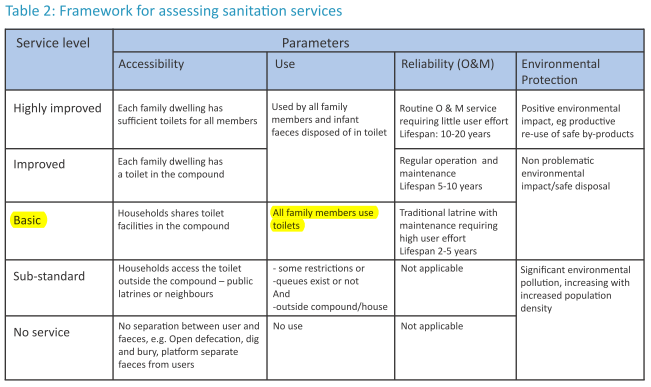
I consider that definition right. In parallel there is the table 2 in the publication
ghana sanitation
That says again that if “some family members have access” it is enough for basic access! In my opinion it changed from right to wrong for the definition of basic service (see my post about the infosheet ).
So the basis for the calculator is not right.
My main concern about the calculator is the false security of a “tool” in hands of somebody who is validating ... “50 governments, multilaterals, training institutions, International NGOs and donors are either using or planning to use the life-cycle costs approach.”
There are many people who do not understand that specific numbers are better than generalized numbers and they do not understand that a tool is a help and not the ultimate point for decision, They do not understand that a range of 10 between numbers means a very broad area for interpretation. So the typical situation will be:
• You came to a life cycle cost of X for a specific solution and you as well show the costs for an alternative X+Y.
• The use of the calculator “proves” that your numbers are wrong …. as it uses other (general) border criteria and other assumptions and come to the solution that the other solution is better than your solution. So your solution is out, most of the times you will not have the possibility to show the error.
• There will be a hint for the application “specific numbers are always better than generalized default numbers “ – but nobody will follow that out of laziness.
My solution for that would be a tool that obligates the user to put in some work and own thinking to come to a result … a tool that obligates the user to actively put in at least the sensible data by her/himself.
Not to ramble on without any reaction I do stop here and wait for comments.
Thanks
Christoph
Attachments:
-
table2cost.png
(Filesize: 85KB)
Please Log in to join the conversation.
You need to login to reply- dwumfourasare
-

- Dr. Bismark Dwumfour-Asare has PhD and MSc in Water Supply, Environmental Sanitation and Waste Management from the Civil Engineering Department of Kwame Nkrumah University of Science and Technology (KNUST), Kumasi, Ghana. He also holds a BSc in Biochemistry. He is currently an Associate Professor at AAMUSTED, Ghana.
Less- Posts: 9
- Karma: 2
- Likes received: 2
As WASHCost is spreading its LCCA methodology for costing sustainable water, sanitation and hygiene services worldwide, Ghana too is not left out with some lasting impressions so far for the past five years. Check out some briefing notes from the WASHCost Project in Ghana, attached.
you can also check here:
www.washcost.info/page/198
Dept. of Environmental Health and Sanitation.
Asante Mampong Campus
Akenten Appiah-Menka University of Skills Training and Entrepreneurial Development (AAMUSTED)
Ghana
This message has attachments files.
Please log in or register to see it.
Please Log in to join the conversation.
You need to login to reply
Toolkit, guideline and excel model for a standardised approach to cost-benefit analysis
There was also a post from July in the IRC website that mention they are releasing soon, probably during the course, a prototype of an online tool, the WASHCost calculator. The idea is that with this tool, we'll be able to better plan, budget, manage and evaluate WASH service delivery models. www.irc.nl/page/73087
Let's see what comes from this training. I'll be glad to share with you some impressions.
Best regards,
Cecília.
and the SuSanA Secretariat
Please Log in to join the conversation.
You need to login to reply- Forum
- categories
- Markets, finance and governance
- Financing (taxes, tariffs, transfers) and cost estimates
- Re: Toolkit, guideline and excel model for a standardised approach to cost-benefit analysis